Is William Hill a scam or legit in Suriname?
A locked account is where the real test begins
Imagine opening the familiar betting service, completing a deposit and later finding that your account is locked when you try to withdraw. The important questions are not whether the name is well known or whether a review page looks positive. They are whether you reached the exact host, whether the operator and licence record match, what identity checks were requested, and which authority can receive a complaint.
For Suriname, the verified packet supports an amber assessment. A foreign regulator record identifies williamhill.com and places it in a United Kingdom licensing context. That record does not prove that the service is authorised in Suriname, nor does it prove that a Suriname account can be opened, funded or paid out without restriction. No account test was performed, and no current primary Suriname record matching the exact domain and operator was found.
The practical conclusion is limited: the exact domain has a documented foreign regulatory record, but its Suriname legal position remains open evidence. Treat any locked-account or unpaid-balance story as something to document and escalate, not as proof of fraud by itself.

The exact host and the identity record
The host to check is williamhill.com. A clone may use a near-identical spelling, an unfamiliar country-code extension, a shortened link or a different payment page. A genuine-looking logo is not enough. Before logging in, inspect the complete address in the browser, including the spelling immediately before the first single slash after the domain.
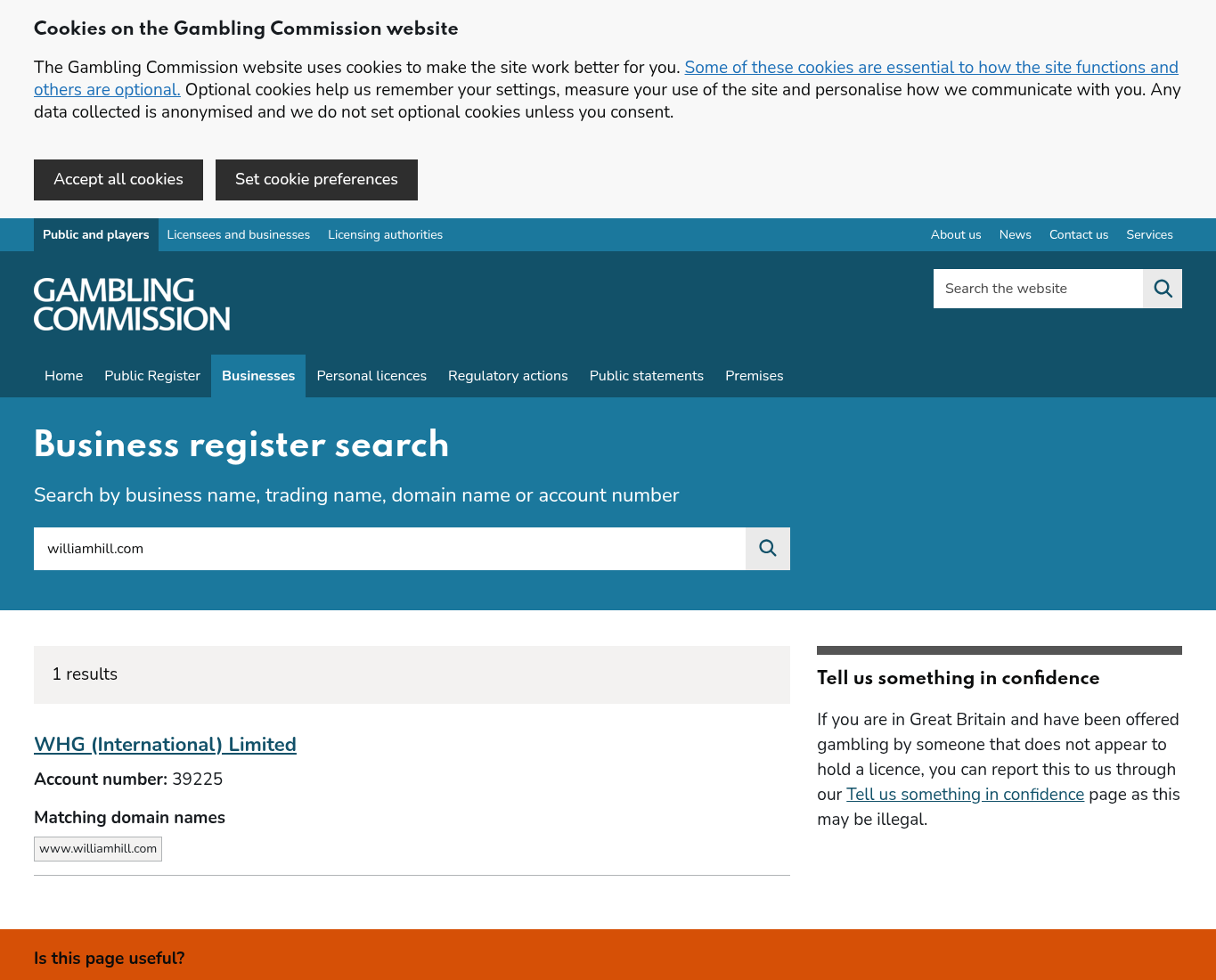
The verified operator supplied for this dossier is WHG (International) Limited. The supplied licence context is UKGC account 39225, with the exact domain active in Great Britain. The foreign regulator’s record identifies the domain and stated operator/licence context, but its scope is not a Suriname authorisation. That distinction matters: a licence in one jurisdiction cannot automatically be presented as a local permit in another.
The foreign regulator’s public register record is the primary identity cross-check, not evidence of local legality.
| Check | Verified position | What it does not establish |
|---|---|---|
| Exact host | williamhill.com appears in the supplied foreign regulator record | That every advert, mirror or mobile link leads to this host |
| Operator | WHG (International) Limited | That a local Suriname company is involved |
| Licence context | UKGC account 39225; active in Great Britain | Suriname authorisation or unrestricted local service |
| Licence expiry | No expiry date supplied | That the record remains unchanged after the checked date |
The check was dated 24 August 2026 in the evidence packet. A later change, regional restriction or account-specific decision is not ruled out.
Is it legitimate or a scam?
“Legitimate” has several parts. A real domain may belong to a real operator and still be unavailable in a particular market. A valid foreign record may support identity, while leaving local legality and practical account access unresolved. Conversely, a complaint about a locked account may describe a real customer experience without proving that the operator deliberately withheld funds.
On the evidence available, the service should not be labelled a confirmed scam. There is a primary foreign record supporting the stated domain and operator context. It also should not be labelled fully verified for Suriname, because the packet contains no current primary Suriname authorisation matching williamhill.com and WHG (International) Limited. That is why the signal is amber rather than green.
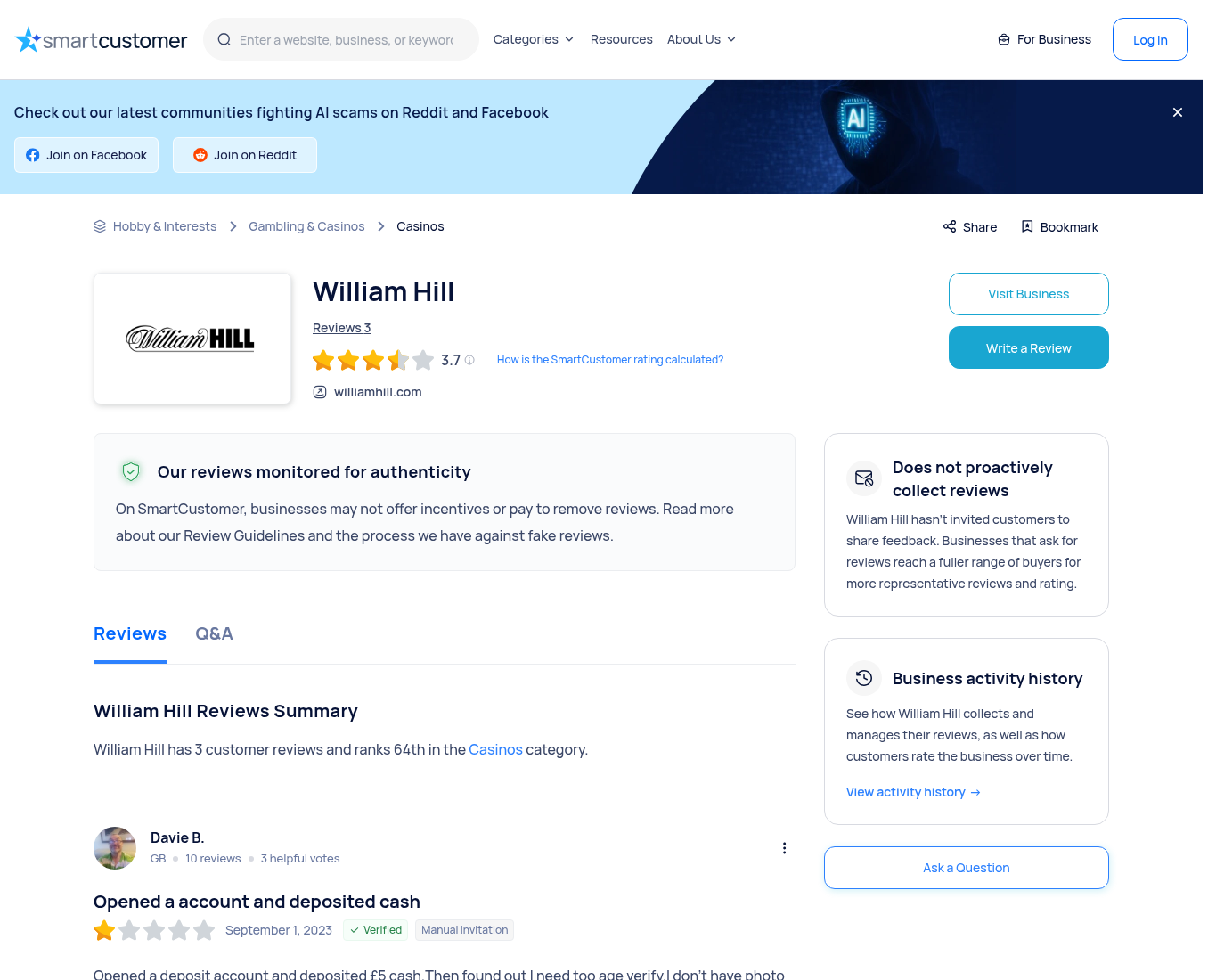
An independent page aggregates user-submitted comments and ratings about the domain. Such material can indicate recurring questions worth investigating, but it is not proof of any particular allegation, payment failure or account outcome. The independent review page is contextual evidence only.
| Question | Evidence-led answer | Confidence boundary |
|---|---|---|
| Is the domain invented? | No; it is identified in the supplied foreign regulator record | The record does not validate every link using the brand name |
| Is the operator identity supported? | Yes, within the stated foreign licence context | No matching local Suriname entity was supplied |
| Is it legal for a Suriname resident? | Not established by this packet | Do not treat the foreign record as a local permit |
| Is every complaint true? | No conclusion is possible from user-submitted comments alone | Each allegation requires its own dated evidence |
What the licence record actually proves
The record supports a narrow proposition: the foreign regulator identifies the exact domain and the stated operator/licence context, with UKGC account 39225 and activity in Great Britain. It does not establish a licence expiry date, a Suriname permit, a right to serve every resident, a successful withdrawal, or the absence of account restrictions.
This is a useful example of why licence language must be precise. “Regulated somewhere” is not the same as “licensed where I live.” A page that displays a regulator name may also be copied by a clone, so the safest route is to start from the regulator’s own record and compare the complete domain and operator name.
The local evidence has a different function. The supplied government page identifies the TCIK/Gaming Board as the authority designated to supervise gambling and provides a citizen reporting point. It does not state, in the supplied claim, that this operator is authorised. Read the Suriname Gaming Board information when checking where a local concern should be reported.
| Record type | Supplied finding | Safe use |
|---|---|---|
| Foreign primary register | Exact domain and foreign operator/licence context identified | Verify identity and foreign status |
| Local government information | TCIK/Gaming Board identified as gambling supervisor with a citizen reporting point | Identify the local escalation channel |
| Independent user page | User-submitted context is aggregated | Spot questions; never treat ratings as a ruling |
KYC and the locked-account scenario
No account was opened or tested for this dossier. There is therefore no verified finding about how quickly identity checks are completed, which documents are accepted, whether a particular Suriname document works, or how a withdrawal is handled.
If an account is locked, first preserve the exact host, account email, date, displayed message and transaction references. Do not create multiple accounts to bypass a restriction, send documents through an unverified message link, or disclose more personal information than the official support process requires. Keep copies of submitted documents and note when each request was made, but redact unnecessary identity numbers when retaining records for a complaint.
A KYC request is not, by itself, evidence of a scam. Gambling services may request identity, address, payment ownership or source-of-funds information. The important unresolved point here is not whether KYC exists in general, but what this service requires from a Suriname customer and whether the request came through the exact, verified host.
| If the service asks for… | Record before responding | Do not assume |
|---|---|---|
| Identity document | Request date, stated reason and official submission route | That every upload link is genuine |
| Address evidence | Accepted document type and account name | That a local document will automatically be accepted |
| Payment ownership proof | Transaction reference and payment method | That a third party may fund the account |
| Additional review | Case number and response deadline | That a delay proves deliberate withholding |
Deposits, balances and withdrawals
The packet contains no verified payment-method list, deposit test, withdrawal test, processing time, fee record or balance evidence. Do not present a payment logo, a displayed method or an advertised limit as proof that a Suriname customer can use it successfully. Availability can depend on residence, currency, verification status, payment ownership and local restrictions.
Before depositing, record the currency, minimum and maximum amounts, displayed fees, wagering or bonus conditions, and the name shown at the payment step. A successful deposit is not proof of a successful withdrawal. If money is placed in an account, keep the confirmation, transaction identifier, balance screenshot and any terms shown at that time. Never send a second payment merely to “unlock” a withdrawal without independently checking the request and preserving the evidence.
For an unresolved balance, ask support for a written explanation, the exact verification item outstanding and the conditions for release. Avoid making a public allegation that goes beyond the documents you possess. A payment delay can have several explanations, but a clear chronology allows the operator and the competent authority to assess it.
| Payment question | Current evidence | What to verify yourself |
|---|---|---|
| Which methods work in Suriname? | Unknown | The cashier shown after a verified login and the applicable terms |
| Are deposits accepted? | No account test | The account’s currency, method, fee and confirmation |
| Are withdrawals successful? | No withdrawal test | A small, documented withdrawal only if local access is lawful and suitable |
| Is a balance protected? | No balance evidence | Account statements, transaction records and written support replies |
For broader checks, use the internal guide on checking payments, rather than relying on a badge or a third-party list.
Clone checks before login
A clone can copy colours, wording, a logo and even a regulator image. Start with a fresh browser address entry and compare the complete host with williamhill.com. Do not treat an advertisement’s visible label as the destination. Expand shortened links, inspect redirects and stop if the final host changes unexpectedly.
Check that the login page remains on the exact host before entering credentials. Be cautious if a page asks for a wallet transfer, gift card, private messaging contact or an urgent “verification fee.” Those features are risk signals, not proof by themselves, but they justify stopping until the destination and payment recipient are independently verified.
| Clone warning | Safer response |
|---|---|
| Misspelled or extra-word domain | Close it and type the exact host manually |
| Regulator logo without a register link | Search the regulator record independently |
| Urgent payment or withdrawal fee | Do not pay; save the request and seek formal clarification |
| Support contact only in private chat | Use the official account route and retain the case number |
| Different operator name at payment stage | Pause and reconcile the identity before proceeding |
If a login was entered on a suspected clone, change the password through the verified service, secure the email account and contact the payment provider promptly. Do not reuse the compromised password elsewhere.
Complaint escalation and evidence preservation
Start with a written complaint to the service through its verified support channel. State the account identifier without unnecessarily exposing personal data, give a dated chronology, list deposits and withdrawals, attach relevant confirmations, and ask for a specific resolution. Request acknowledgement and a case number. Keep the original messages and note every response.
If the issue concerns local gambling supervision or a suspected unlawful service, the supplied government information identifies the TCIK/Gaming Board and its citizen reporting point. Submit a factual report with the exact host, screenshots, transaction references and dates. Separate what you personally observed from what another person posted. Do not describe an allegation as a proven offence unless a competent dated record establishes that conclusion.
A foreign licence record may identify a regulator with jurisdiction over the stated foreign context, but the packet does not provide a separate complaint outcome or direct escalation decision. The local and foreign routes should not be confused: one helps identify a Suriname supervisory contact, while the other relates to the foreign record.
| Complaint stage | Include | Keep out |
|---|---|---|
| Operator support | Dates, case number, exact request and transaction evidence | Passwords, full card numbers and unnecessary identity data |
| Local report | Exact host, local impact, chronology and attachments | Speculation presented as fact |
| Foreign record query | Domain, operator, account reference and precise question | Claims that the register guarantees a payout |
| Follow-up | New response, deadline and unresolved point | Repeated duplicate submissions that obscure the timeline |
You can also review the internal complaints and scam warnings guide for a structured record of an incident.
Evidence chronology and method
The supplied records were checked on 24 August 2026. The foreign primary record was used for the exact-domain and operator/licence proposition. The independent page was treated as user-submitted context, not as verification of a complaint. The local government page was used for the identity of the TCIK/Gaming Board and the stated citizen reporting point.
The method separates four questions: identity, jurisdiction, account performance and adverse conduct. Identity has supporting foreign primary evidence. Suriname jurisdiction is unresolved. Account performance is untested. Adverse conduct is not established by the supplied user context. This separation prevents a familiar name from becoming an unsupported legal conclusion.
Our methodology and scoring explains how primary records, operator statements, user reports and unknowns are kept distinct. The result can change if a current primary Suriname record matching williamhill.com, WHG (International) Limited and Suriname is verified, or if a competent authority publishes an adverse finding.
Current signal, limits and correction path
The current signal is amber — open evidence. It is not a recommendation to deposit, and it is not a finding that the operator is fraudulent. It means that the foreign identity record is useful but insufficient for a Suriname legality conclusion, while account access, payments and withdrawals remain untested.
Before relying on the service, confirm the exact host, establish whether local access is permitted, read the applicable account and payment terms, and avoid committing funds that you cannot afford to leave unavailable during verification. Use the internal licence and law guide for the legal-check framework and responsible gambling information for safer-play support.
If you can provide a dated primary record that matches williamhill.com, WHG (International) Limited and Suriname, or a competent authority’s adverse decision, send it through contact with the source URL and a short explanation of the precise claim. Corrections should distinguish a changed record from a new allegation. Until such evidence is verified, the amber assessment remains the most accurate description of the packet.
If, after checking the evidence, you decide to visit the service, use the supplied View the checked selection. This link is not evidence of authorisation, availability or a successful outcome.
Frequently asked questions
Is William Hill a scam in Suriname?
The supplied evidence does not establish that it is a scam. A foreign regulator record identifies the exact domain and operator/licence context, but no current primary Suriname record matching them was found. The appropriate signal is amber, and local legality, account access and withdrawals remain unresolved.
Is William Hill legal in Suriname?
That is not established by the verified packet. The UKGC record concerns a foreign licensing context and does not prove Suriname authorisation. Check the TCIK/Gaming Board information and seek a current local record before treating the service as locally authorised.
Does the licence record guarantee that my withdrawal will be paid?
No. The record supports the stated foreign domain and operator/licence context, but no withdrawal test or balance evidence was supplied. A licence record is not proof of a particular account outcome, payment method or processing time.
What should I do if my account is locked?
Preserve the exact host, account message, dates, transaction references and support correspondence. Contact the service through its verified channel, request a case number and ask which precise verification step remains. Do not create duplicate accounts or pay an unverified unlocking fee.
How can I spot a clone?
Compare the complete browser host with `williamhill.com`, inspect redirects and verify the operator record independently. Be cautious with misspellings, shortened links, private-chat support, unexpected payment recipients and urgent requests for extra money. A copied logo is not proof of authenticity.
Where can I report a local gambling concern?
The supplied government information identifies the TCIK/Gaming Board as the gambling supervisor and provides a citizen reporting point. Include the exact host, dates, factual chronology and supporting records, while clearly separating your own observations from user-submitted allegations.