BoyleSports in Suriname: licence and safety check
A mobile advert can make a betting service look local before a player has checked where the address leads. A banner, social post or app link may open a page using the BoyleSports name, but the useful trail starts with the final hostname: boylesports.com. The next questions are who operates that domain, which regulator record matches it, and whether that foreign record says anything about permission to serve Suriname.
The evidence available for this review gives a cautious answer. The exact domain appears in a United Kingdom Gambling Commission record connected with Boylesports Enterprise and UKGC account 39469. That is a foreign regulatory record. It does not establish a Suriname licence, local authorisation or protection under Surinamese law. No account test was performed, and no current primary Suriname record matching both the domain and operator was found. The overall signal is therefore amber: open evidence.
Quick verdict for Suriname
| Question | Evidence-based answer | What remains unconfirmed |
|---|---|---|
| Does the exact domain have a foreign regulatory record? | Yes. The supplied UKGC record identifies boylesports.com in the stated operator and account context. | The record does not prove permission in Suriname. |
| Is the operator identified? | The packet names Boylesports Enterprise. | A current Suriname-registered entity matching the service was not established. |
| Is it legal for a Suriname player? | The supplied evidence does not answer that question positively. | Local authorisation, permitted products and territorial rules remain unconfirmed. |
| Was a withdrawal or account test completed? | No. | Payment success, identity checks, withdrawal timing and dispute handling remain untested. |
| Are user comments proof of a scam? | No. They are contextual user-submitted material. | Individual allegations, dates, account details and outcomes were not independently established. |
The word “legit” needs to be split into separate checks. A real foreign business record is not the same as local legality. A functioning hostname is not proof that every advertisement or application link is genuine. User ratings are not a substitute for a regulator’s decision. On the supplied record, a player should not treat the foreign licence as confirmation of Suriname access.
Follow the advert to the final address
The practical mobile trail has four stages: advert, redirect, final address and account screen. Start by pressing and holding a link, where the device allows it, rather than assuming the visible campaign name is the destination. Note the first address, any redirect, and the final browser address after the page settles. The relevant exact host in the evidence packet is boylesports.com.
A safe comparison is not based on a logo alone. Check the spelling character by character, including the ending after the final dot. Look for added words, substituted letters, unfamiliar country endings, hyphens, or a lookalike character. A short link can conceal the destination until it opens. An application downloaded from an advert may also be separate from the browser service, so compare the publisher, package name and linked domain rather than assuming that a familiar colour scheme proves ownership.
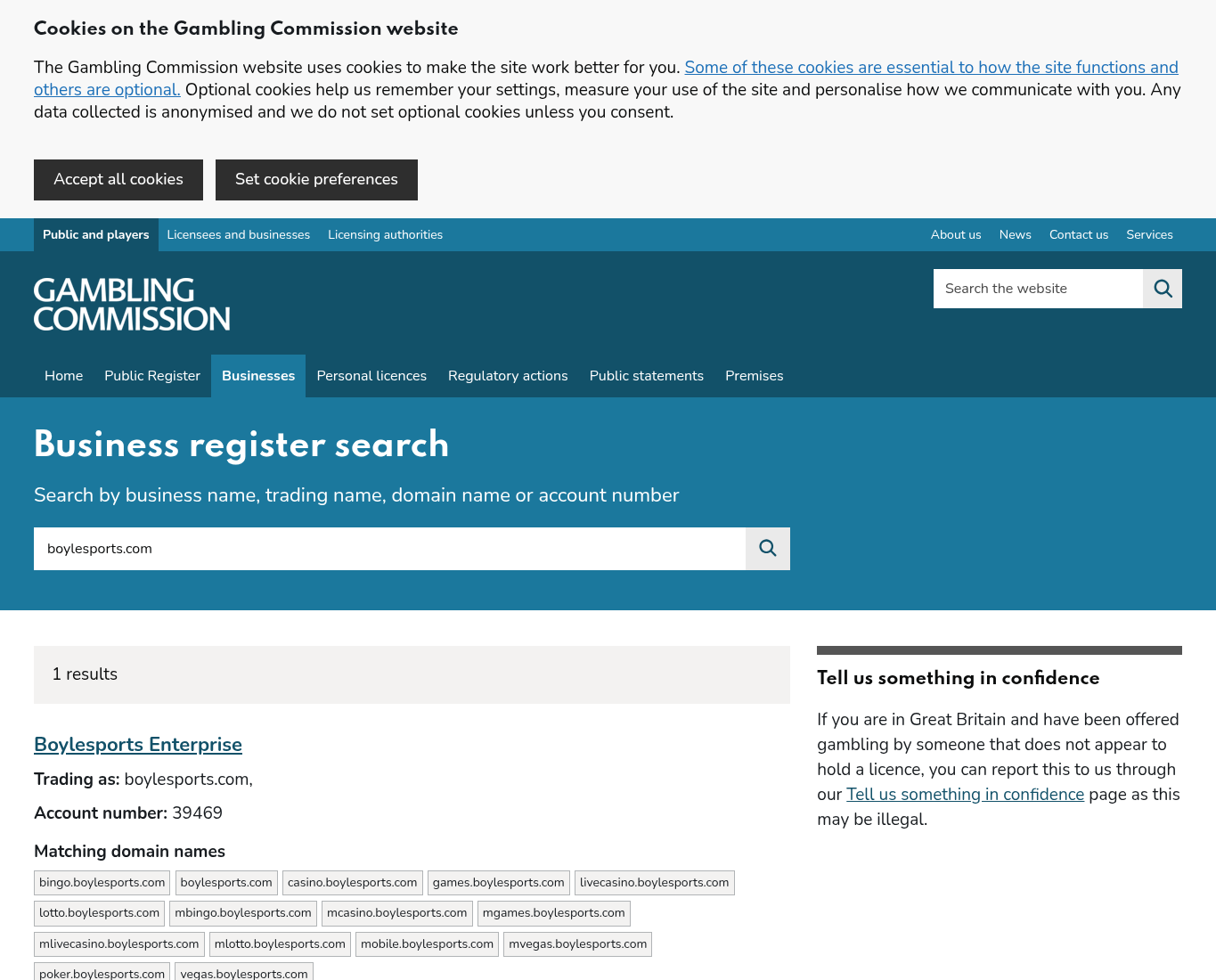
The supplied official capture is useful as a record of the regulator search, not as proof that a particular advert, application or social account is genuine.

Hostname and operator match
The central identity test asks whether the exact address and named operator appear together in a competent primary record. The supplied United Kingdom Gambling Commission entry is the relevant record for that comparison. It identifies boylesports.com and gives the stated operator context of Boylesports Enterprise, with UKGC account 39469.
That match supports a narrow conclusion: the foreign regulator record is relevant to the exact domain named in the packet. It does not automatically cover a different address, mirror, mobile package, payment intermediary or promotional account. It also does not convert a foreign record into local approval. A player should preserve the final address, the date checked and any account or payment screen if a dispute later concerns identity.
The record is dated 2026-08-24 in the supplied evidence ledger. No licence expiry date was supplied. Absence of an expiry date in this packet is not evidence that a licence has expired or remains current; it is simply an unresolved field.
| Identity item | Supplied finding | Practical meaning |
|---|---|---|
| Exact hostname | boylesports.com | Compare every entry point with this spelling. |
| Named operator | Boylesports Enterprise | Use the legal name shown in the record when preserving evidence. |
| Foreign account | UKGC account 39469 | Relevant to the United Kingdom record, not automatically to Suriname. |
| Local entity | Not established | Do not infer a Suriname company or permit. |
| Licence expiry | Not supplied | Current status requires a fresh primary check; it cannot be guessed. |
Foreign licence versus Suriname legality
A regulator can confirm a business relationship within its own jurisdiction, while a different country decides whether an operator may offer gambling services to people there. The supplied UKGC evidence therefore gives some identity context but cannot answer “is it legal in Suriname?” by itself.
The local source names Het TCIK/de Gaming Board as the designated gambling regulator and provides a citizen reporting point. That is the appropriate local route for asking about authorisation or reporting a suspected gambling service. The source does not, in the supplied claim, confirm that the exact domain and operator are authorised in Suriname. It would be unsafe to turn the existence of a reporting point into a licence finding.
A player seeking a local answer should ask the regulator to assess the exact hostname, the named operator, the offer shown, the intended market and the date of access. Save the address and relevant material first. A response about a different brand, a different domain or a different entity should not be treated as a match.
The local regulator’s public information can be checked at the Gaming Board notice and citizen reporting point. That link is supplied as a local regulatory reference, not as evidence that the service is approved.
Payments on browser and mobile routes
The packet does not verify a payment method, bank, electronic wallet, card processor, minimum deposit, currency, fee, settlement time or availability for Suriname. Those details must therefore remain unknown. A payment icon on a landing screen does not show that the method is available to a particular resident, that a deposit will be accepted, or that a withdrawal will be processed.
Before depositing, record the payment name, currency, fees, stated limits and the account name receiving funds. Compare those details with the operator name shown in the account and terms. Avoid sending money to a personal account, a changing wallet address or an intermediary whose relationship is not explained. A payment request made outside the verified service is a separate risk signal, even if the message uses familiar branding.
| Payment question | Status in the packet | Practical evidence to retain |
|---|---|---|
| Which methods accept Suriname deposits? | Unknown | Dated cashier screen and displayed country selection. |
| Are fees charged? | Unknown | Fee disclosure before confirmation and transaction receipt. |
| Which entity receives funds? | Unknown | Recipient name, reference and payment confirmation. |
| Are deposits reversible? | Unknown | Provider terms and support response. |
| Can the method be used for withdrawals? | Unknown | Withdrawal screen showing the same method or stated alternative. |
A browser route and a mobile application may present different payment screens. Do not assume that an application’s availability means that the underlying service is locally authorised. No application package or mobile payment path was tested for this dossier.
Withdrawals and KYC remain untested
There is no withdrawal test in the evidence packet. That means no supported statement can be made about processing time, rejected withdrawals, partial payments, reversals, fees or the quality of support during a cash-out. Deposit acceptance would not fill that gap. A service may accept a deposit while requiring additional information before releasing funds, and the supplied records do not show how such a case would be handled.
Know-your-customer checks are also unconfirmed. The packet does not establish which identity documents are requested, when verification begins, whether address or payment ownership evidence is needed, or how personal information is stored. Do not upload identity documents merely because an advert or message demands them. First confirm the exact hostname, the account area, the stated operator and the secure support route. Mask unnecessary document numbers when retaining screenshots for a complaint.
| Account stage | What is not verified | Cautious step |
|---|---|---|
| Registration | Country eligibility and accepted identity evidence | Read the current eligibility wording before creating an account. |
| Deposit | Payment ownership and local availability | Use only an account or method in your own name where permitted. |
| Verification | Documents, timing and review criteria | Keep the request and submission date; do not send documents to an advert contact. |
| Withdrawal | Processing, fees and possible holds | Save the request confirmation and every status change. |
| Dispute | Escalation route and response times | Keep a dated chronology and payment references. |
These are verification limits, not allegations. No unsuccessful withdrawal, withheld balance or improper identity request was established.
Complaints, reports and preserving proof
A complaint should distinguish what happened from what is suspected. Write down the exact address, date and time, device route, account identifier, payment reference, amount, message received and response. Preserve original emails and screenshots without editing the relevant address or timestamps. If a screenshot contains unnecessary personal data, create a redacted copy for general sharing while retaining the original securely.
For an account or payment dispute, use the service’s documented support route first if it is available and safe to access. State the remedy sought, such as an explanation, correction or withdrawal review, and give a reasonable deadline based on the terms you actually received. Do not send passwords, one-time codes or full payment credentials in a complaint.
For a suspected unauthorised gambling service in Suriname, the supplied local regulator source provides a citizen reporting point. Include the exact domain and operator name, but separate direct observations from conclusions. “The address displayed was…” is stronger and safer than “the company is a scam” when the record does not establish that conclusion.
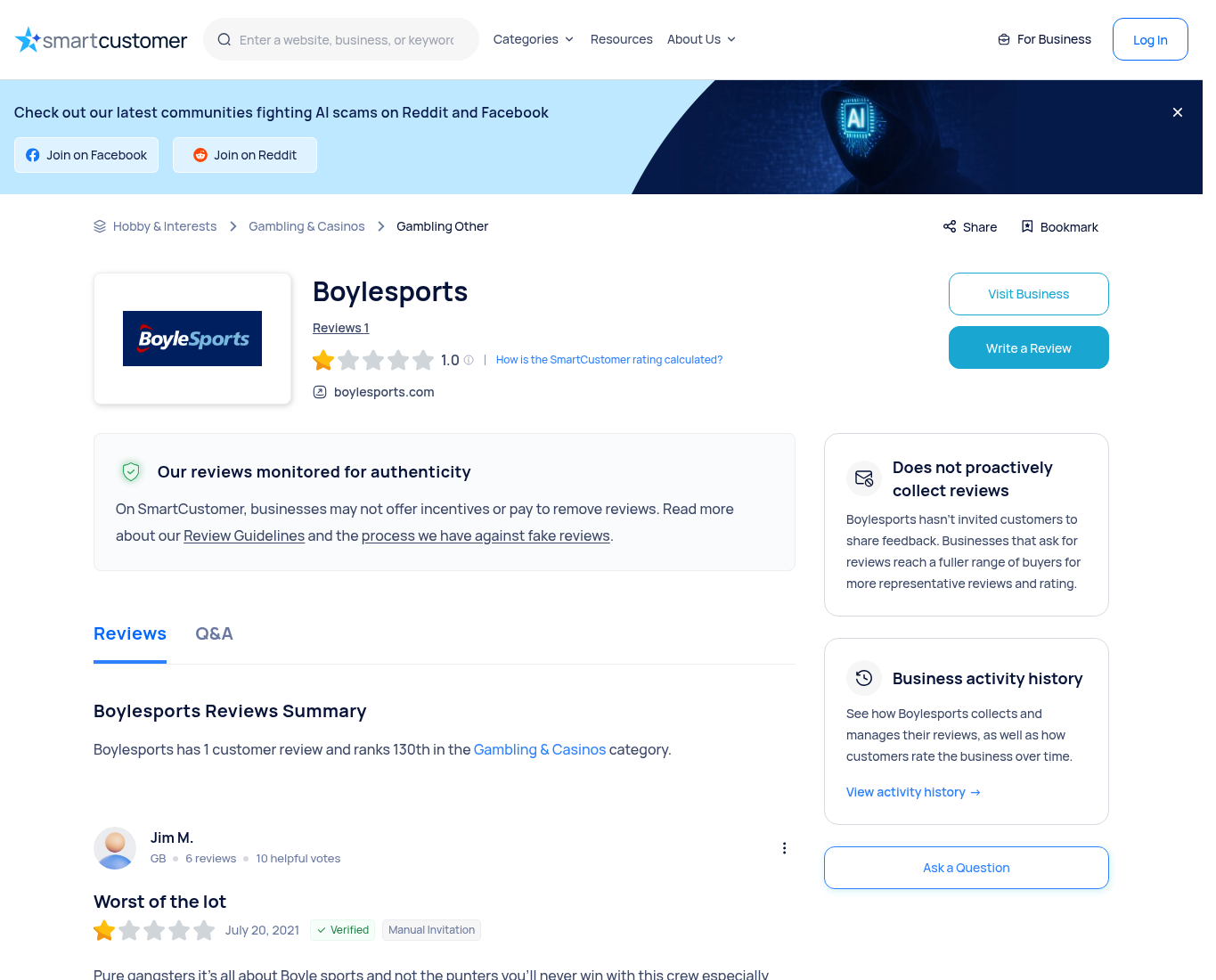
The independent context source may help identify recurring themes, but it is not a decision-maker. The independent user-submitted context page contains comments and ratings that require caution: they are not proof of any specific allegation, and the packet supplies no independent account-level verification or outcome.
Clone, redirect and payment-scam checks
A clone check should be completed each time an advert or message offers a new route. Compare the final hostname with boylesports.com, inspect the connection address, and look for a sudden request to continue through a private messenger. A copied logo, matching colours or a familiar slogan proves little. A supposed support agent who asks for a password, one-time code, remote-access installation or payment to unlock a withdrawal should be treated as unverified.
Check the address before logging in, not after entering credentials. If the route differs, close it and reach the service through a previously saved, verified address rather than through the same campaign. Keep a separate record of the address that opened and the address that finally loaded.
| Warning sign | Why it matters | Safer response |
|---|---|---|
| Extra word or altered spelling in the hostname | It may be an impersonation or unrelated service. | Stop and compare the address character by character. |
| Urgent message about a blocked withdrawal | Pressure can push a player into an unsafe payment. | Verify through the documented account route. |
| Request for a fee before releasing funds | The packet does not establish any such charge as legitimate. | Do not pay an unknown recipient; preserve the request. |
| Private chat asks for a password or code | These credentials can enable account takeover. | Refuse, end the chat and change credentials if exposed. |
| Payment recipient differs from the stated operator | The money trail may not match the claimed service. | Pause and obtain a documented explanation. |
Evidence chronology and method
The evidence ledger records all three supplied sources as checked on 2026-08-24. The UKGC record is the primary foreign regulatory source for the exact hostname and operator context. The local Gaming Board notice is a primary local regulatory source describing designated oversight and a citizen reporting route. The independent page is contextual user-submitted material; its presence does not verify individual reports.
The method is deliberately narrow. First, compare the precise hostname rather than the brand label. Second, separate the foreign regulator’s record from the question of Suriname authorisation. Third, classify user material as context rather than proof. Fourth, mark payment, withdrawal and KYC details as unknown where no test or dated primary record was supplied. Finally, state the date and limits so that a later correction can replace an outdated conclusion without silently changing the evidence basis.
The resulting signal is amber, with basis open evidence. It is not a red finding: no official adverse decision or corroborated documented adverse evidence was supplied. It is not green: current primary evidence matching the precise domain and operator in Suriname was not supplied.
For a broader explanation of how identity, regulatory and user-context material are weighed, use the internal guide on methodology and scoring. Payment-specific checks are described in payment checks, while local legal questions can be compared with licence and law guidance.
Correction path and practical decision
A correction should identify the exact claim that has changed, the source that supports the change, the date checked and the precise hostname or legal entity involved. A new record about a similarly named service is not enough. The strongest update would be a dated primary Suriname record matching boylesports.com and Boylesports Enterprise, or an official adverse record concerning that same pairing.
Until such evidence exists, do not describe the service as locally licensed, guaranteed to pay, or safe because it appears in a foreign register. If you choose to continue researching, first verify the final address, read the applicable eligibility and payment terms, avoid sending funds or identity documents through unverified contacts, and preserve a complete chronology. A cautious reader may use the supplied View the checked selection only as the provided commercial next step, while understanding that the evidence does not establish Suriname authorisation and that no account or withdrawal test was completed.
gamblingcommission.gov.uk
Frequently asked questions
Is BoyleSports a scam in Suriname?
The supplied evidence does not establish that conclusion. A foreign UKGC record identifies boylesports.com in the stated operator context, while no current primary Suriname record matching the domain and operator was found. User-submitted comments are contextual and no account test was performed, so the appropriate signal is amber rather than a definitive scam or safety verdict.
Is BoyleSports legal in Suriname?
The packet does not prove Suriname legality or local authorisation. It identifies Het TCIK/de Gaming Board as the designated gambling oversight body and provides a citizen reporting point, but it does not supply a local licence record matching boylesports.com and Boylesports Enterprise. A local answer requires confirmation from a current Suriname primary source.
Does the UKGC record cover Suriname players?
No such conclusion can be drawn from the supplied record. UKGC account 39469 and the exact-domain entry are relevant to the foreign regulatory context. They do not automatically establish permission, consumer protection or lawful availability in another jurisdiction.
Were payments and withdrawals tested?
No. The packet contains no deposit test, payment-method verification, withdrawal request, processing result or account review. Consequently, availability for Suriname, fees, processing times, possible holds and support performance remain unknown.
How can I check a BoyleSports clone?
Compare the final address character by character with boylesports.com, record redirects, inspect the publisher of any application and avoid private contacts requesting passwords, one-time codes or release fees. A copied logo or familiar advert is not sufficient proof of identity. Preserve the address and messages if a suspected clone is encountered.
Where can I report a suspected unauthorised service?
The supplied local source identifies Het TCIK/de Gaming Board and provides a citizen reporting point. Include the exact hostname, operator name, dates, screenshots and payment references, while separating what you directly observed from any allegation. Keep original evidence secure and redact unnecessary personal information in copies shared more widely.