Betfair in Suriname: domain, licence and clone check
The first check is not the colour scheme, a familiar name or a convincing sign-in screen. It is the address: betfair.com. A lookalike address can imitate a recognised service while sending identity documents, passwords or deposits somewhere unrelated. Before entering any information, compare every character with the exact domain and reject additions, substitutions, unusual prefixes or different endings.
The available evidence supports a narrower conclusion than a simple “safe” or “scam” label. A current foreign regulator search links the exact domain to Betfair group entities and active accounts in Great Britain. That is useful evidence for the domain-operator relationship abroad, but it does not prove authorisation in Suriname. No current primary Suriname record matching the domain and operator was supplied, and no account, deposit or withdrawal test was performed. The resulting signal is amber.
Quick verdict: legit domain record, open Suriname question
| Question | Evidence-based answer | Confidence |
|---|---|---|
| Does a regulator record identify the exact domain? | Yes. The UK Gambling Commission search lists betfair.com in the stated operator and licence context. | Strong for Great Britain |
| Does that record establish Suriname authorisation? | No. A foreign registration cannot be treated as a Suriname licence. | Clear limitation |
| Is there proof that every similarly named address is genuine? | No. Only the exact domain in the record is supported. | High clone risk if the address differs |
| Were deposits, identity checks or withdrawals tested? | No account test was performed. | Unknown |
| Is the service proven to be a scam? | No such conclusion is established by the supplied records. | Unsupported |
| Is unrestricted use in Suriname established as legal? | No current matching local record was found in the packet. | Open question |
“Legit” therefore needs to be divided into separate questions. The exact domain has a traceable foreign regulatory record. The supplied material does not establish local authorisation, payment reliability for a Suriname customer, successful withdrawals or the authenticity of any other address. An amber result means verification is still required; it is neither an accusation nor an endorsement.
Start with the exact-domain and clone test
A fraudulent copy does not need to reproduce every function. It only needs to persuade a visitor to disclose a password, one-time code, card detail, wallet transfer or identity document. The safest comparison is character by character, before sign-in and again before payment.
| Check | Expected observation | Stop immediately when |
|---|---|---|
| Domain | The address is exactly betfair.com | Extra words, misspellings, hyphens, altered letters or another ending appear |
| Connection | The browser shows a normal encrypted connection | A certificate warning, forced download or security bypass appears |
| Sign-in path | Navigation remains on the verified domain | A message or advertisement redirects credentials elsewhere |
| Payment request | Terms, recipient and amount are visible before approval | Payment is requested through chat, a personal account or an unexplained wallet address |
| Support contact | Contact details are reached from the verified service | An unsolicited account asks for passwords, codes or remote access |
Do not rely on a search advertisement, social-media profile, shortened link or copied logo as proof. Type the known domain independently or use a previously verified bookmark. If a message claims that an account is blocked, do not follow its link. Open a separate browser window and navigate independently.
A clone may also reproduce licence wording. The decisive point is whether the regulator’s own record connects the precise domain and relevant legal entities. The supplied foreign search does that for betfair.com in Great Britain; it says nothing about a different spelling or a supposed local mirror.
What the foreign regulator record establishes
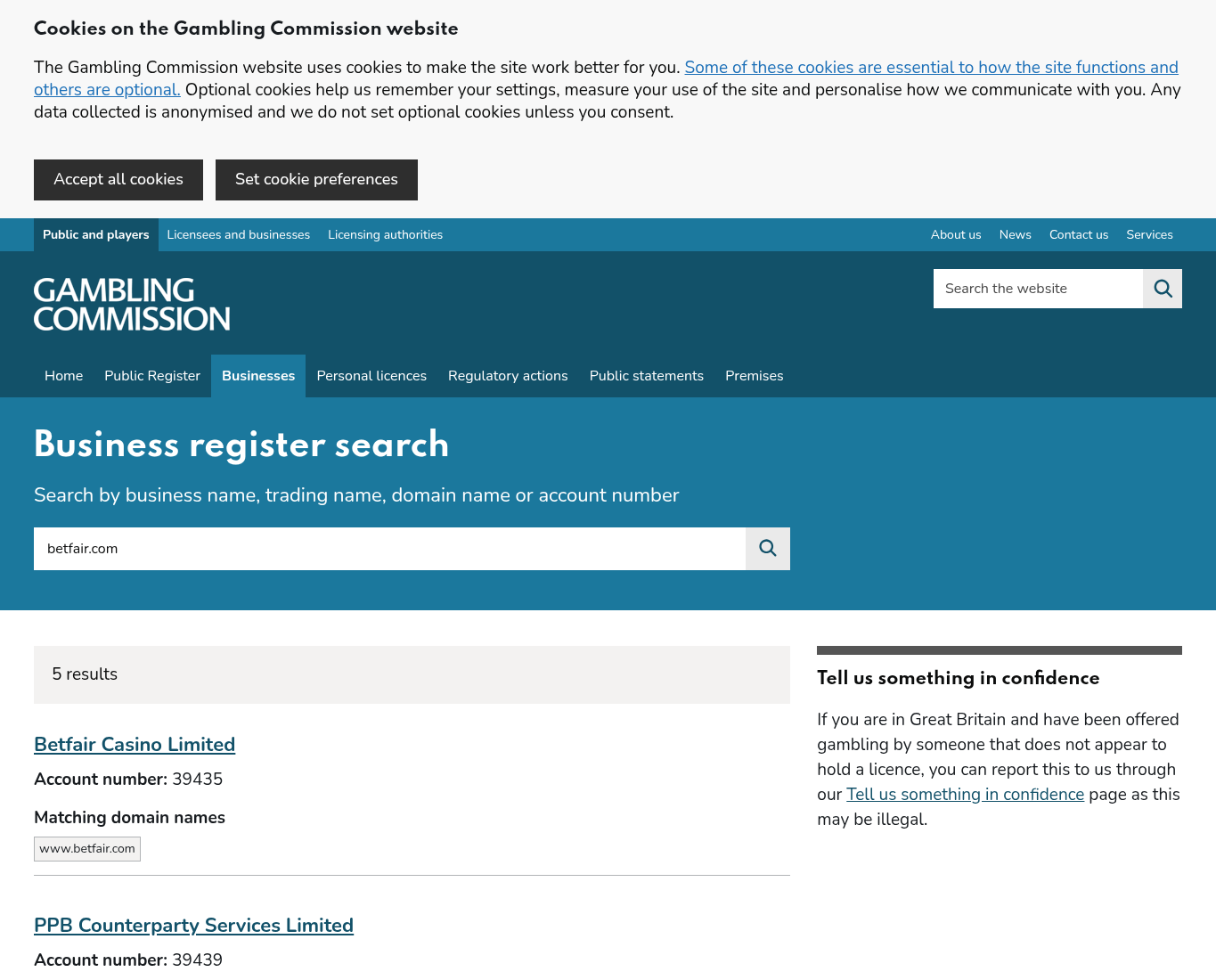
The UK Gambling Commission public-register search was checked on 24 August 2026. It identifies the exact domain and lists Betfair group entities under multiple active Great Britain accounts. This is primary evidence for the limited proposition that the domain appears in that foreign regulatory context.
It does not automatically answer whether a person in Suriname may lawfully register, gamble, receive promotions or use a particular payment method. Regulatory permissions are territorial. A record maintained for Great Britain must not be relabelled as a Suriname licence, and the absence of a supplied local match must not be converted into a claim that local authorities have issued an adverse decision.
| Record element | Supported interpretation | Interpretation not supported |
|---|---|---|
| Exact domain | betfair.com is identified in the foreign register search | Every lookalike or redirected address belongs to the same group |
| Listed entities | Betfair group entities appear in the stated account context | One unnamed entity handles every Suriname-facing transaction |
| Active Great Britain accounts | The listed foreign status was active when checked | Permanent status or permission in every country |
| Check date | The search was reviewed on 24 August 2026 | A guarantee that nothing changes after that date |
The precise entity responsible for an individual account, payment or dispute should be read from the terms presented during registration and from transaction records. The packet does not map a Suriname customer journey to one legal entity, so that detail remains unknown.
Suriname legality remains unconfirmed
The local government notice says that Het TCIK/de Gaming Board is designated as the gambling supervisor and provides a public reporting point. The Suriname government notice and reporting route was checked on 24 August 2026. This supports the identity of the local oversight channel; it does not list the exact domain and operator as authorised in the evidence supplied here.
A cautious legal check asks three separate questions: which body supervises gambling, whether the specific domain and responsible entity appear in a current local record, and whether the offered product is permitted for the customer’s location. Only the first question is supported by the local source in this packet. The second and third remain open.
Do not treat availability as legality. A website loading in Suriname, accepting a registration form or displaying Suriname dollars would not by itself establish local permission. Likewise, a foreign licence does not settle local tax, consumer, advertising or participation rules. For a current answer, compare the exact domain and named contracting entity with primary local information, or ask the designated authority using the reporting route.
Sign-in, identity and account exposure
Entering credentials creates risk before money is deposited. Reused passwords can expose unrelated accounts, while a copied sign-in form can collect a password and one-time code in real time. Use a unique password and never approve an unexpected authentication request. A genuine-looking support conversation is not proof of identity.
Identity verification may involve sensitive documents, but the packet does not establish which documents are requested from Suriname customers, when checks occur, how long they take or which entity stores the data. Do not infer those details from another market. Before uploading anything, confirm the exact domain, read the displayed privacy and account terms, and verify that the request appears inside the authenticated account rather than in an unsolicited message.
If a caller or chat contact asks for remote access, a complete password, a one-time code or payment to “unlock” verification, stop. Preserve the message and navigate independently. If documents were already sent to a suspected clone, record the address, time and files disclosed; change reused credentials; notify relevant financial providers; and consider the local public reporting point.
Payments and withdrawals: what is known and unknown
No deposit or withdrawal test was performed. The packet supplies no verified list of payment methods, fees, currencies, limits, processing times or Suriname availability. It also does not establish whether a specific bank, card issuer or wallet will accept or reverse a transaction. Those points must remain unknown rather than being filled with assumptions based on brand recognition.
| Stage | Verify before proceeding | Evidence status |
|---|---|---|
| Deposit | Exact recipient, currency, fee, minimum, ownership and refund terms | Not tested |
| Identity check | Required documents, responsible entity and secure submission path | Not established for Suriname |
| Withdrawal | Eligibility rules, destination, limits, review conditions and quoted timing | Not tested |
| Failed transaction | Bank reference, account ledger entry and support case number | No case supplied |
| Currency conversion | Exchange rate and charges shown by both service and provider | Unknown |
Take a dated record of the displayed amount, currency, fee and recipient before authorising a payment. Keep the confirmation and transaction reference. For a withdrawal, preserve the request time, status, quoted conditions and any later request for documents. These records do not prove wrongdoing, but they make a bank query or complaint more precise.
Do not send additional money merely because someone promises it will release an existing balance. A request for a “tax,” “verification deposit” or transfer to a personal account needs independent verification. If the payment recipient differs from the entity named in the applicable terms, pause and ask for a written explanation through a channel reached from the verified domain.
Complaints, user reports and recovery steps
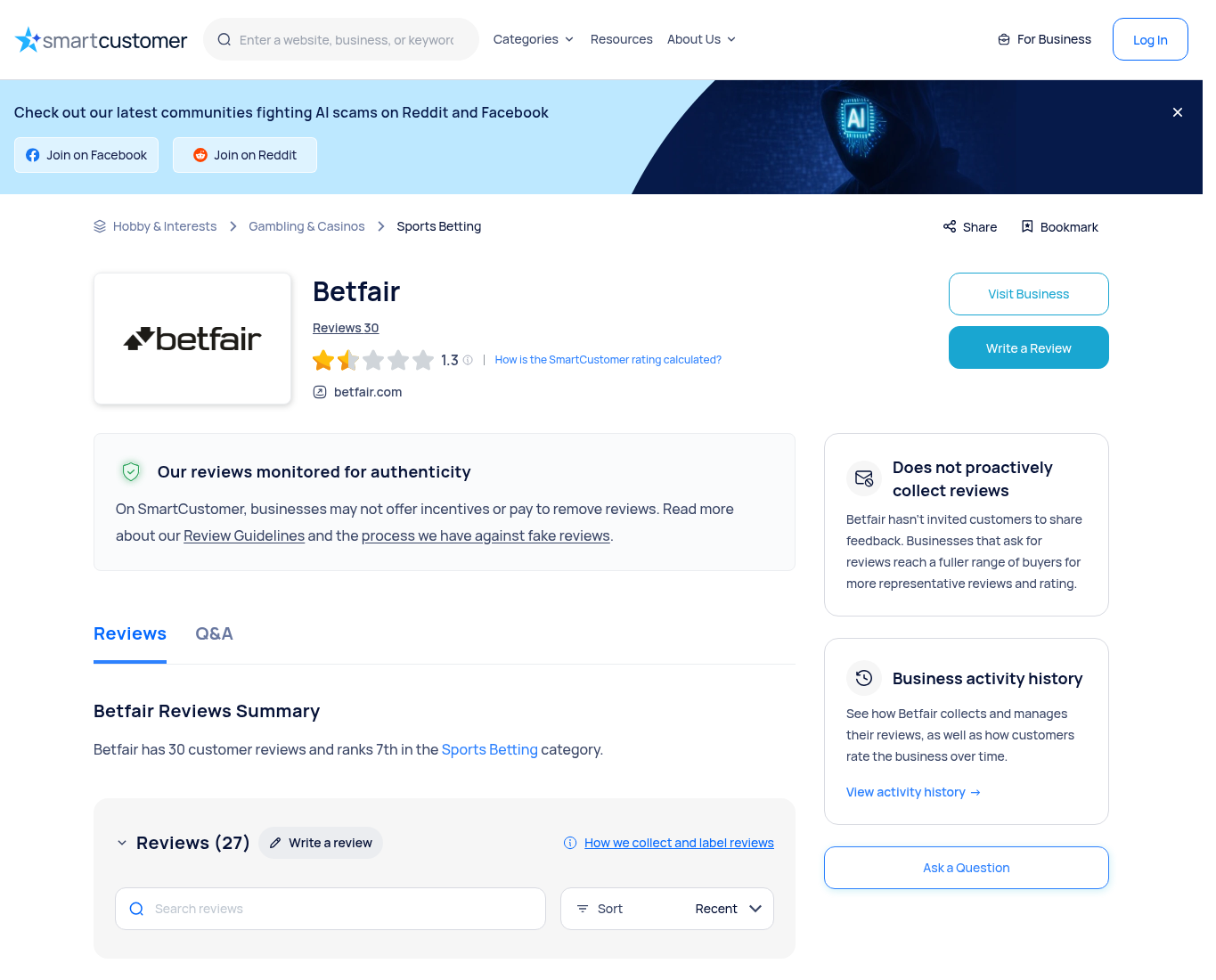
The independent user-review collection was checked on 24 August 2026. It aggregates user-submitted comments and ratings about the domain. Such material can reveal topics worth checking, but it cannot prove that an individual allegation is accurate, representative, current or connected to the same account conditions. It is context, not a regulatory finding or a substitute for transaction evidence.
For an account or payment problem, first write a factual timeline: registration address, displayed contracting entity, transaction references, amounts, currency, status changes, support replies and requested remedy. Remove unnecessary sensitive information from copies. Use the service’s complaint channel reached from the verified domain and request a case number.
If the issue concerns a suspected clone, do not continue negotiating through the suspicious channel. Contact the bank, card issuer or wallet provider promptly, explain whether credentials or money were exposed, and ask what protective or dispute steps are available. Change compromised passwords and secure the associated email account. For a Suriname-facing concern, the designated local reporting point is the relevant primary route in the supplied evidence. General preparation is available in the complaint and scam-warning guide.
Main risks behind the amber signal
The largest unresolved issue is jurisdictional: the exact-domain match is foreign, while a current Suriname authorisation match was not found in the packet. A second limitation is operational: there was no account journey, identity-check, deposit, support or withdrawal test. A third is entity precision: the foreign register lists group entities, but the material does not establish which entity would contract with every Suriname customer.
| Risk | Why it matters | Practical control |
|---|---|---|
| Lookalike domain | Credentials or payments can be diverted | Compare every character with betfair.com |
| Foreign-only licence evidence | Great Britain status does not prove Suriname permission | Seek an exact local domain-entity match |
| Untested withdrawals | Timing, checks and outcomes are unknown | Start only after reading terms and retaining records |
| Unverified payment recipient | Funds may go to an unexpected party | Confirm recipient before approval |
| User-report overreach | Anecdotes may be mistaken for established facts | Separate reports from primary findings |
| Status changes | Register information can change after checking | Recheck dated primary records |
Amber is appropriate because there is meaningful primary evidence for the exact domain abroad, but material local and operational questions remain open. Red would require an official adverse record or corroborated documented evidence not present here. Green would require current primary support for the precise domain and entity in the relevant local context, which is also absent.
Anyone choosing to continue should first complete the clone checks, confirm current eligibility and terms, establish the responsible entity, and understand the payment and withdrawal conditions. The single optional route to the service is View the checked selection. Do not proceed if the address, recipient or legal information differs from what was independently verified.
Evidence chronology and checking method
All three supplied sources were checked on 24 August 2026. The foreign regulator record was used only for the exact-domain and Great Britain account relationship. The Suriname government notice was used only to identify the designated local supervisory and reporting route. The independent review collection was treated only as user context. No source was stretched to support a different jurisdiction or an untested customer outcome.
The assessment separates four layers: domain identity, legal or regulatory status, operational performance and reported experience. A positive result in one layer cannot substitute for another. A domain can have a foreign register entry while local status remains uncertain; an authentic domain can still have account-specific disputes; and a user report can describe an experience without proving a general conclusion.
No personal experience, hidden test, support conversation, payment result or withdrawal result is claimed. Empty fields are kept as unknowns. The method and signal definitions are described in methodology and scoring, while general payment verification steps are collected in payment checks.
Corrections and evidence updates
A correction should identify the exact statement, provide a dated primary record where possible, and explain whether it concerns the domain, legal entity, jurisdiction, licence status or customer process. A screenshot without its original record address is insufficient for a regulatory correction because images can become outdated or lose context.
Material that could change the signal includes a current Suriname primary record matching the exact domain and responsible entity, an official adverse notice naming them, or corroborated documentation of a specific operational issue. A new user comment alone would remain contextual. A foreign status change would affect the foreign finding but would not independently settle Suriname legality.
Corrections can be submitted through contact. Include no passwords, one-time codes, full payment credentials or unnecessary identity documents. Records should be rechecked because the conclusions are tied to the 24 August 2026 review date.
Frequently asked questions
Is Betfair a scam or legit in Suriname?
The exact betfair.com domain appears in a current UK Gambling Commission search connected with Betfair group entities and active Great Britain accounts. That supports a foreign domain-operator relationship, not Suriname authorisation or guaranteed safety. No official record in the supplied packet establishes that the service is a scam, and no account test was performed, so the evidence signal is amber.
Is Betfair licensed in Suriname?
No current primary Suriname record matching betfair.com and the stated operator was supplied. The available licence evidence concerns Great Britain. The Suriname government source identifies Het TCIK/de Gaming Board as the gambling supervisor and provides a public reporting point, but it does not establish a local licence for this exact domain.
How can I recognise a fake Betfair address?
Compare the address character by character with betfair.com. Stop if there are added words, misspellings, hyphens, substituted letters, another domain ending, a certificate warning or a redirect to an unrelated sign-in or payment page. A copied logo, search advertisement or social-media account is not proof of ownership.
Are payments and withdrawals proven reliable?
No. There was no deposit, identity-verification or withdrawal test, and the packet contains no verified Suriname-specific methods, fees, limits or processing times. Confirm the recipient, currency, charges, responsible entity and withdrawal conditions before paying, and retain dated transaction records.
What should I do if a payment or account is blocked?
Create a factual timeline with transaction references, amounts, status changes and support messages. Contact support through the independently verified domain and request a case number. If a clone or unauthorised payment is suspected, contact the payment provider promptly, secure compromised accounts and use the designated Suriname reporting route where appropriate.
Can user reviews prove fraud or safety?
No. User-submitted reviews may highlight issues worth investigating, but they do not prove a particular allegation, overall safety or a regulator’s conclusion. They must be checked against account records, transaction evidence and dated primary sources.